On this page
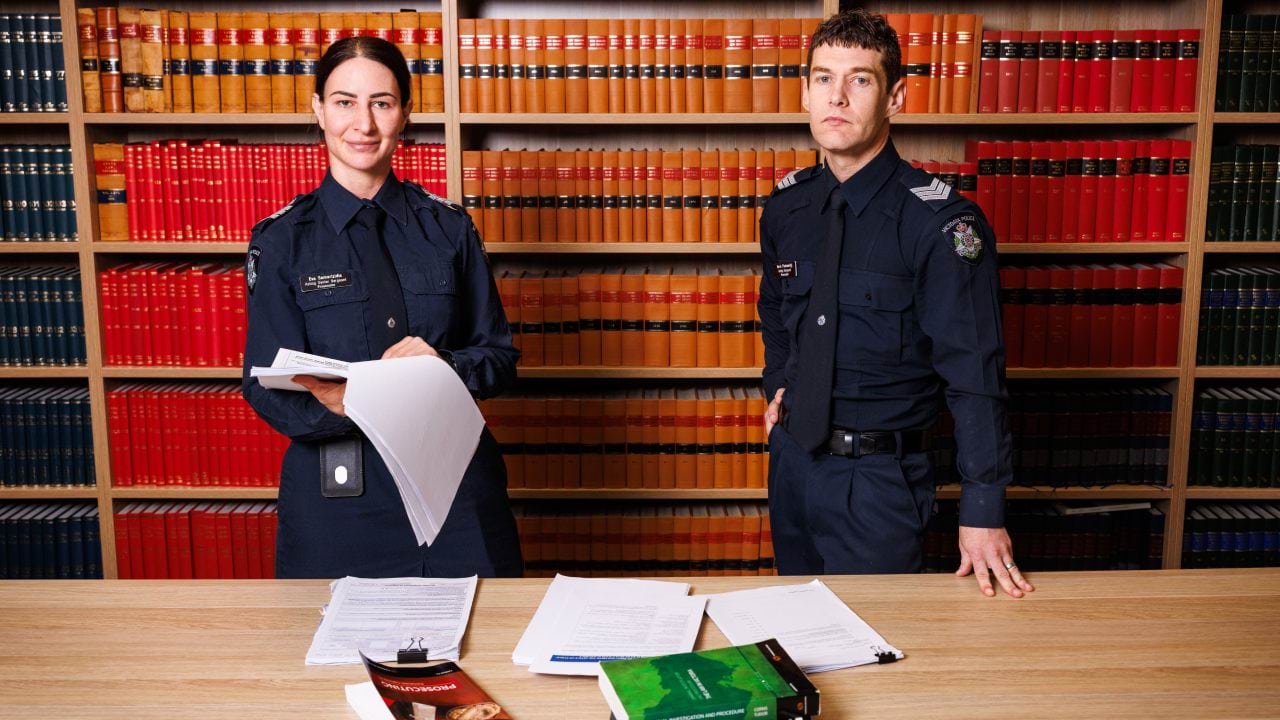
A lot rests on the shoulders of police prosecutors whose job it is to stand up in court and fairly present the work of their frontline colleagues who are arresting and charging offenders.
We speak to two prosecutors about how they navigate the theatre of the courtroom in what is one of the most highly-specialised roles at Victoria Police.
Listen to Season 5 Episode 2: Holding court
You can also listen to the Police Life podcast on Apple Podcasts, Spotify, Audible, or wherever you get your podcasts.
Episode transcript
Read the transcript for Police Life: The Experts - Season 5 Episode 2
[Atmospheric music builds and then the sound of three loud knocks, a door opening and shuffling sound of people moving.]
Acting Sergeant Kevin Paslawskyj: You take your suitcase, you walk in, the magistrate knocks, the three knocks, and the door opens and the magistrate walks down and you stand up and it's game on.
Voiceover: For most police, all their hard work on an investigation comes to an end when the case is presented at court. But for a highly specialised group of Victoria Police officers, that’s exactly when the work begins.
While the investigating officer may have spent weeks or months working on the matter, the police prosecutor they hand it over to might have just mere minutes to make it all count in the courtroom.
Being a prosecutor can be an intense role, sometimes with a huge daily workload. They must have a very particular set of skills and legal expertise and, to survive in the drama of the courtroom, they often need to operate at their full mental bandwidth.
But for the kind of police officers who are drawn to the role, those demands are the moments they thrive on.
Acting Senior Sergeant Eva Semertzidis: It's exactly what I wanted to do. I wanted the intellectual challenge and I definitely get that intellectual challenge on the daily.
I'm Eva Semertzidis. I'm an acting senior sergeant at Melbourne Prosecutions. I've been there for approximately 10 years, and prior to joining Prosecutions, I was on the van only for a couple of years. I knew exactly what I wanted to do because before that I was a registrar at the courts, and I used to frequently see prosecutors appearing in court, and I thought, “Yep, that's exactly what I want to do”. And I joined, Academy, on the road for a little bit, and straight into Prosecutions.
A/Sgt Paslawskyj: People often say the prosecutor can be the most powerful person in the courtroom. We're an advocate of the court. The magistrates look upon us to guide them. We have a duty to the community. And I really respected the position, so I chose to pursue it.
My name's Kevin Paslawskyj. I'm an acting sergeant at Melbourne Prosecutions also. I joined Prosecutions Unit at the commencement of 2022. After four and a half years out on the road, I worked at three different police stations, all different demographics.
Prior to policing, I was working for Maurice Blackburn Lawyers and prior to that I was working with the Australian Federal Police where I did six and a half years. So, prosecutions is a blending of my two previous careers and hence the path that I've chosen.
A/Sen Sgt Semertzidis: I thought I knew this guy, and we've worked together for a few years, and I think I sat in kids' court as his acting senior sergeant, and now I had no idea that you work for a law firm or being in the AFP. So hi, Kev, nice to meet you.
[Eva and Kev both laugh]
[Atmospheric music in background.]
Voiceover: Eva and Kev are two of the more than 450 police prosecutors at Victoria Police. While lawyers from the Office of Public Prosecutions are responsible for presenting criminal cases in the County Court and Supreme Court, the duty is performed in Magistrates’ Courts and Children’s Courts across the state by sworn police officers who have studied to achieve the added qualification of police prosecutor.
A/Sen Sgt Semertzidis: You've got Magistrate's Court and they deal with summary offences. Summary offences could be something like a trespass or use profane language.
And then you've got your indictable offences, triable summarily. So, you've got possession of drugs, thefts, assaults, robberies, etcetera.
County Court, you'll hear matters such as rape, commercial quantity of drug, possession, trafficking, and then you go to the Supreme Court and you'll hear things such as murder, manslaughter, extortion.
A/Sgt Paslawskyj: Yeah, it's like a pyramid. So, bulk of the matters are down the bottom, which we deal with, and get smaller as you get to the top.
Voiceover: The course to qualify as a police prosecutor takes a minimum of a year to complete. And even then, many prosecutors – such as Eva – will go even further by studying a law degree as well.
A/Sen Sgt Semertzidis: With Victoria Police, and this might not be known to everybody, but you do attain credit points towards a law degree. So, once you finish your academy training and then you complete the prosecutorial course, you'll receive credit points toward the law degree.
For me, it took, I would say, somewhere between six to seven years to complete, which was quite a long time. I was studying part-time because I was working full-time. And once I finished that I completed my practising certificate through College of Law, which was another six months part-time and I was recently admitted in the Supreme Court as a lawyer on the 24th of August.
A/Sgt Paslawskyj: Well done.
A/Sen Sgt Semertzidis: So, yay, I'm a real lawyer now. And people think that you have to be a lawyer to be a prosecutor. That's a bit of a misconception out on the general public think, “Oh, you must have a law degree”. No, not necessarily. We're taught the material that we need to know and the Evidence Act and Crimes Act, Bail Act, all the ones that we utilise in the Magistrates' Court, we're taught on the course. But when you do law degree, you go through every single area of law.
Voiceover: Police prosecutors are perhaps a lesser-known part of Victoria Police. And, with that, come other misconceptions – as a colleague of Eva’s once discovered.
A/Sen Sgt Semertzidis: So, he was prosecuting a contested hearing, so the accused didn't want to plead guilty, he wanted to contest the charges. And he had a victim, and they stood it down for the accused to be represented by a barrister.
And my colleague explained to the victim. She said, “Why have we stood down? I thought this was going go ahead”. And he said, “Yeah, we've stood down so he can get a barrister”. And he was quite nonchalant about it. He didn't really give it much. And she turned around and said to him, “A barrister? What? He gets a barrister and I just get you?”
And he just said, he said, “Eva, I was just gobsmacked”. But I can understand the misconception. I mean, because it's got such a prestigious name, but hey, we appear in court every day. We're experts in our field. So, we do both the role of a solicitor and a barrister. But I do understand the general public's misconception around why barrister sounds better than a prosecutor.
[Atmospheric music builds.]
Voiceover: Just recently, two Victoria Police prosecutors were recognised for their distinguished legal careers by being appointed as magistrates. They are Superintendent Sherrill Handley and Senior Constable Abdoullah Fakhouri. It’s the first time ever that serving Victoria Police officers have become magistrates.
A/Sen Sgt Semertzidis: And I guess that adds to another level of, we're not just Victoria Police prosecutors, that were boots on the ground, did a bit of study and now we're prosecuting. There's actually a lot more to that, so there's potential for others to get there as well. So that's one thing.
A/Sgt Paslawskyj: Yeah, great recognition for the work that prosecutors do. Yeah, just another milestone in Victoria Police history.
A/Sen Sgt Semertzidis: It didn't matter what rank, because you've got – look at the disparity, you've got a superintendent and a senior constable. So, the rank didn't matter to them. It was, I guess, the background and the expertise and what they wanted at that time.
Voiceover: Eva was first drawn to the role when she worked as a court registrar before joining Victoria Police. In case after case, she saw how being a police prosecutor demanded not only legal know-how, but a real sense of artistry to argue the merits of a case.
A/Sen Sgt Semertzidis: There was a lot of theatrics. So, some would use glasses as props and to hold them and move around as if they were casting for a movie. Or there was others that were really gentle and kind to witnesses. Our witnesses aren't always just police informants, they're general members of the public. They might be a child, they might be a vulnerable person.
So, the way they phrase those questions were completely different. So, cross-examining an accused, the style that they would have in that way would be different to how they would question a victim in the box. So that was really nice to see and I learnt a lot from that, seeing how different prosecutors operated.
I also saw when to stop asking questions and the magistrate was like, okay, that's enough, or gave the look like, "That's enough", but they weren't picking up on that. So, I always learnt to make eye contact with the magistrates so I knew where I was heading. It was like, ask questions, and then just see the magistrate make a funny look, and it was like, yeah, I won't ask that question anymore. Yeah.
A/Sgt Paslawskyj: And it's really about reading the room.
A/Sen Sgt Semertzidis: You have to read the play.
A/Sgt Paslawskyj: Yeah, like Eva said, it's the little cues from the magistrate, knowing when to stop, knowing enough is enough. And if you don't pick up on them, then that sets the tone for the rest of the day.
Voiceover: A prosecutor’s ability to zero in on important details in a brief of evidence can often make or break a case.
[Atmospheric music starts.]
A/Sgt Paslawskyj: There was this one case where I had a young accused. And defence were contesting it on the basis that identification wasn't made out. And the prosecution case came down to some unique markings on a pair of shoes and shoelaces. And that set of shoes was consistent through multiple briefs of evidence. But the face wasn't visible – or the face was visible to a degree. Prosecution would say it was made out. Defence were contesting otherwise.
However, we got to court one day and defence were going to move the matter onto a contested hearing. We're standing there, final negotiations with defence, only moments before we walked into the courtroom, and the young girl turned up.
[Sound of a door opening and atmospheric music.]
And I guess this also draws on the skills that good prosecutors should have and it's attention to detail. And I'd been looking at these photos and images consistently leading up to this day, and this young girl walked in, and there it was. Those significant pair of shoes that I had clearly seen in multiple photos. It was that jaw-dropping moment. I looked at another prosecutor who I was with on the day and I was standing there with defence.
But I just said to her, I said, “Have a look at your client's shoes”. And she turned around and she's like, paused [music stops abruptly] and she said, “I'll be back in a moment”. And she walked into the room, had a discussion with her client and she walked out only two or three minutes later and she said, “We'll plea to everything”.
And I just thought, you know, how silly could you be? But I guess that's one of those skills of a prosecutor, and like I say, that jaw-dropping moment.
Voiceover: While prosecutors in higher jurisdictions may have plenty of time to familiarise themselves with a brief of evidence – the document in which the investigating police officer details all the alleged offending by the defendant – police prosecutors in the magistrates’ court are encountering briefs for the first time on the day of the case.
A/Sen Sgt Semertzidis: In a typical quiet day, you might have 20 briefs in the Magistrates Court, Adult Jurisdiction.
A/Sgt Paslawskyj: Couple of hours in the morning.
A/Sen Sgt Semertzidis: Yeah. Um, busy day, um, 150. Yeah. 150. No word of a lie.
A/Sgt Paslawskyj: And you're preparing for that the morning of, and court starts at 10.
A/Sen Sgt Semertzidis: And when Kev says preparing, preparation isn't all that glamorous. It's literally taking them out of your suitcase and putting them in alphabetical order on your bar table and as they get called, you're reading the information.
It's definitely difficult. If you're working in a Mention Court, for example, and you might have 30 briefs. I know people are listening out there who are from our office are going, “No, there's more than that”. But let's say 30. You've never seen them before. You've never read the brief before. You know what it looks like. You know where to find things.
But you're picking up a brief and you're essentially reading something that you have never seen before and presenting it to the court fairly. But the magistrate doesn't have a copy, so they don't know what's coming next. They have to take notes. We have to talk slowly sometimes so that they can either type it out or take notes and get an accurate assessment of what are the facts in the case.
And whilst you're doing that, your brain's already ticking, “Right, so I know what the charges are in that brief” and in your head you're trying to amount the points of proof in the facts to make sure that you're covering all the points of proof in that charge. So, your brain's really working in overdrive and if you're doing that throughout the whole day, it's very tiring.
So going into court, although I've only read that brief once, I know how to think like a copper. I've been there, I've been on the road. I know why they would operate. So, when a magistrate would say, “Acting Senior Sergeant Semertzidis, “Why did the police officers not do this? Or why did they do this in this particular instance?” I would be able to provide some information based on that. So, it's important that we had that operational background and that we were still operationally competent.
And then sometimes you might have, you'll be in court and you'll have a barrister next to you and you have an instructing solicitor and you will be on your own. And there's other times where …
A/Sgt Paslawskyj: It's a lonely place.
A/Sen Sgt Semertzidis: Yeah, it's a lonely place on that bar table. And then you might have a couple of barristers because they might be co-accused and then two other solicitors opposite them providing instructions. And again, you are by yourself and you're appearing in court and your mind has to be all over it, everything that's in front of you.
A/Sgt Paslawskyj: Thinking on your feet. It's something we do probably without giving ourselves enough credit for because just through time and process we've become accustomed to it.
Voiceover: While they might be Victoria Police officers, police prosecutors are not there just to serve their police colleagues. They are not there to back up absolutely every charge their colleagues bring against a defendant. They are there, first and foremost, to serve the court and community more broadly.
A/Sgt Paslawskyj: Some of my most challenging conversations have been with my colleagues because they are the ones that are out there arresting individuals. They become emotionally invested in the briefs of evidence. They put a lot of time and effort into what they produce and have the ongoing relationship with the victims. And then we assess the brief. And we might have to tell them that the charges aren't made out or we're withdrawing the whole brief. And some of those conversations, if they're emotionally invested and put a lot of work into their briefs, can be the most challenging conversations that I've had.
A/Sen Sgt Semertzidis: We may not say eye to eye with investigators or members on the road that are, don't get me wrong, they are working tirelessly to get these briefs through and they're detecting offences and so they should, they're doing their job. But the court doesn't look at hypotheticals, it doesn't look at emotion, it looks at facts.
So, the best thing that we can do to sustain those relationships with our colleagues is to give them the time and say, “This is the reason why we've withdrawn it”. There might be things that they haven't considered. They're looking at it from an investigative perspective, we're looking from a legal perspective.
Voiceover: One of the most important roles of a police prosecutors is to make sure the courts and defendants aren’t dealing with an unnecessarily long, or unproveable, list of charges.
A/Sen Sgt Semertzidis: We withdraw charges based on whether there's enough evidence to proceed on those charges, but other times we have to make that decision, that balancing decision of whether the ends justifies the means.
So, if we have a witness in an incident who's a child, yes, we might be able to prove that charge, but what detrimental effect and what extent are we willing to go to, to place that child in perhaps further trauma. So that's also another assessment that prosecutors conduct when they're negotiating. You wouldn't know that because that's not in the courtroom. There's a lot of out-of-court discussions. So, there are those considerations that are not commonly known, but that do occur.
What's important in being a prosecutor is not to be emotionally attached to matters and look at the facts. Because we're all human. We do read things and we read victim impacts but you really have to take away the emotion and look at the facts and do the job and steer the case in the right way.
And sometimes I can see that prosecutors, and I've also been one of those people where I've put in a lot of work in some cases and I thought, “Gee, that wasn't really the outcome I was looking for”. And sometimes it's also managing the expectation of your witnesses or your victim who also said, “This happened to me and I want him to rot in jail”. Well, that's not necessarily what's going to happen and that's how it operates.
It was interesting, I was reading a book recently about prosecutions and there was a quote and I thought, I'll write this down for this particular podcast, but, “The long tradition of a prosecutor is that they should perform their role as administrators of justice rather than advocates seeking a particular result.”
So, walking in there going, “Right, this is what I know this case is about” and then saying that submitting on jail without looking at the surrounding circumstances isn't, I guess, best practice for a prosecutor. And the quote goes on to say, “It is of course clearly their role to present the Crown's case fairly and fearlessly, but to present in a detached way and not to appear to urge a conviction”. So again, the emotional detachment from that case, sometimes it's not always easy.
[Slow, atmospheric music begins.]
Voiceover: One time when managing emotions was absolutely necessary for Eva, was when she prosecuted a case where the officer who laid the charges and prepared the brief was Senior Constable Vadim de Waart-Hottart. Vadim was one of two Victoria Police officers murdered in Porepunkah in the state’s north-east in August 2025.
Sen/Sgt Semertzidis: I had one of his cases where he did some really extremely good work and that was recognised by the victim.
She couldn't talk highly enough of him and she loved the work that he did and he was very personable with her. It made such an impact that she made note of it as soon as she met me as a prosecutor.
So, what happened was, she was out one night attending a, I think it was the Maroon 5 concert with her children, her adult children, and she was crossing a pedestrian crossing and she was hit by a vehicle. And there were multiple charges on the brief relating to that incident and I made an assessment of that case and watched the footage and determined that there was only one of those charges that I believed could be proven.
I negotiated that matter with the defence lawyer. However, prior to doing that, I spoke to the nominal informant. And what a nominal informant is someone that steps in when the informant's not available. And that nominal informant also worked with Vadim. So, I was not just dealing with a case, I was also dealing with a nominal informant who knew Vadim, so there was an emotional attachment there, and then we also had the victim who had that great experience from Vadim as well. Some really good work there. The brief was well articulated, well put together and it was easy for me to do my job, which I'm thankful for.
And the victim, when I did speak to her and I said to her, "This is the particular charge that we're going to proceed with", she wasn't overly happy with the result. That's not her fault. She's a member of the public that has had no legal background and doesn't understand it. So, it didn't take much for me just to sit there and explain to her the reasoning behind that charge.
She attended every court case. She provided a victim impact statement.
The accused was there. He didn't have any prior history. He wasn't your everyday crook, if I can put it that way. He was a member of public then there was an incident that happened and now he's suffering the consequences. And it took a lot for me to bring her around and talk to her and explain to her, and even the magistrate had to say, “I know you're looking for jail, but this is not going to happen on this occasion. There'll be a penalty that's congruent with what's occurred, but it's not jail”.
And there were lots of tears from the victim. A very emotional day for a lot of reasons, but I think coaching her through it to explain to her why the outcome was this. But I think it just left another one of our members of the public happier with what the outcome was in that circumstance. And afterwards she shed a tear again about Vadim and she said he was so comforting after what happened. The ambulance was there and he was kind, and I watched the footage, and everything she said was absolutely correct. Couldn't be prouder.
I gave her my work email and, on the anniversaries, and anything that pops up on her Facebook feed that reminds her of Vadim, she'll contact me and say, “I just had a thought, and I thought of you, and I just wanted to say thank you”. And I have to say, from the beginning when she wasn't with me about the charges to the end of the result where she was giving me a hug, I felt like I did the best job I could in the role that I was doing.
Voiceover: Although emotional detachment is the goal for prosecutors, sometimes the things they need to read to the court can hit hard.
A/Sgt Paslawskyj: Yeah, there's definitely been times in court where I've been close to crying, especially through my period in the Children's Court jurisdiction, where you see a lot of young victims. And one of those matters that came to mind was a large fight and robbery on an oval with a 16 and 14-year-old siblings who were both of the victims, and it lasted maybe one or two minutes. And the older brother was attacked first and he was robbed of his shoes whilst he was down and unconscious. And the phone footage captured the 14-year-old brother trying to lift up his 16-year-old brother and carry him off the oval, slumped over his body.
You know, that matter came to court and the brothers were actually in court and it was just hearing the victim impact statements, which I had them both write and hearing them read out the impact of the offending. Yeah, there's definitely been times where I have been emotional in court.
Voiceover: There are also times in court where prosecutors need to hold back the laughter.
A/Sen Sgt Semertzidis: Look, I get people don't understand how to appear in-person in court and they can't always afford a lawyer and they might not always be eligible for Legal Aid funding. So, they'll come and appear on their own. And I was in court and it's what's called a judicial registrar list. So, they're not effectively magistrates, they're judicial registrars and they'll hear very low-level offences, so fine offences.
And on this particular case, I was sitting in the courtroom and this European man came up to the bench when his matter was called. And the magistrate said, “You received a fine and you didn’t pay it”. And there was a bit of conversation between the magistrate and him going back and forward. And the magistrate decided to impose an additional fine. And the gentleman got up and said – well, the additional fine was, for example, $150 – and he turned around and goes, “How about I pay 100 today and we finish it all off?” and was negotiating with the magistrate.
And I was sitting there and I just wanted to hide under the table and laugh, but I had to remain professional. But he didn't know. He just thought that that's what you could do. And the poor judicial registrar was sitting there saying, “No, sir, that's not how we operate in this system. This is the fine and these are the court costs and this is what you have to pay”. And he goes, “So there's no way I can move this around, move the price around a little bit?” And she said, “No sir”. And he walked out with his head down and he was pretty disappointed. But anyway, that's a good story to tell.
Voiceover: After working for a few years in the magistrates’ court, Kev has now been specialising as a prosecutor in the Children’s Court. It’s an area of the justice system that he is personally passionate about.
A/Sgt Paslawskyj: The Children's Court's primary focus is rehabilitation. It's a therapeutic jurisdiction. So, the court and defence and prosecution work together to try and identify what the cause of the offending is and have that addressed. Punishment comes secondary. As a prosecution we do hold the children to account. But it's primarily focused on rehabilitating that certain individual, the young person, so that they don't offend again.
Studies will support the fact that – for instance, we'll talk about jail or detention – when you lock someone up and put them away, the long-term effect is more detrimental to the community rather than having them engaged in society, challenging their values and morals, helping build those support and morals, reshaping that individual so they can be a better person in the community.
So, I've been involved in one matter, which was, it went for 18 months, and that's where you really get to see the effects of rehabilitation take place. So, it was a significant incident, high-profile matter where there was an agg home invasion at a party, a Facebook invite went pear-shaped. A young person turned up, they decided to steal some cars in company with some mates. And they left the party in the stolen cars and went through a red light and didn't see an oncoming motorbike. The driver hit the motorbike and the motorbike rider passed away.
And so that commenced in mid-2024 or 23, 18-month process. Didn't go all the way to a contested hearing but, through the court process, the young person was able to engage with services early on. Having a read of the report when it returned to court to finalise, given the engagement with the services that the young person had been involved in, it was probably one of the best reports I had read for the young person.
He came from a background where his family had been in and out of the justice system. He had made it to 17 offence free, so he had no prior criminal history. He saw his mother get bashed and kidnapped in his own home. And these are some of the other things that the community doesn't see. A lot of these children who come from or are involved in the justice system aren't from perfect families. They've got their own difficulties and they're vulnerable from a young age.
[Atmospheric music starts to build.]
But this young person, through the court process and the engagement, had gained full-time employment. He was engaged. His wife was pregnant. He attended a group conference with the victim's family. The victim's family were forgiving because of the way he conducted himself through the process. He made a promise to carry out the wishes of the victim’s family, which was to buy a house and a car and just safe travels.
So, it was a real turning point and to my knowledge he's been offence free since that. So, you know, the incident itself was quite sad but it was a pivotal point for that young person in his life and he turned the corner. Yeah, so you do see some good results come out of the children's court despite what's presented in the media and sometimes, you know, sometimes court does get it wrong but sometimes it gets it right with the services involved.
It's rewarding. That was my motivation for joining the Children's Court team. I felt like I could play more of a role and become involved in changing the direction of young persons’ lives. I grew up playing sport and understand that sport and engagement is a real, it was important for me, kept me on the straight and narrow. And having the opportunity to put things in place, work with diversion and youth justice, yeah, just gave me a better sense of what I was doing.
Reflecting on my childhood, I guess I'm no longer friends with any of the people that I went to school with. I went to a school that, I saw some things that, back then, knives being pulled on teachers and the like.
There were times where I felt lonely, reassessing my friendship group, not going to hang out behind the gym at lunchtime with the cohort of friends that I thought were going to be my friends.
And I just understand that your environment really sets a path for where you are. And the sport was the driver for me because it shaped my friendship group. And a lot of these young people that you deal with in the children's court, they don't have that, or they're still searching for that friendship group that can keep them on the straight and narrow.
Voiceover: A prosecutor’s legal skills and duties might distinguish them from their frontline colleagues, but that doesn’t ever excuse them from the need to go hands-on when needed. Such as when Eva was supervising a fellow prosecutor in court one day.
A/Sen Sgt Semertzidis: And this one sticks out because whilst we're police prosecutors and, yes, we're intellectual and, yes, we've done the course and we have law degrees, most of us. However, that drive inside you of being operational just never leaves.
And I was mentoring a prosecutor who was starting out as a junior prosecutor. And, for context, the case was in relation to a family violence matter and they couldn't find the respondent to serve the paperwork. And I remember facing the door so I could see someone peeking through the little window. And although this person that was the victim was in custody for other matters – and I'll premise this by saying, just because you're an offender doesn't mean that you can't ever be a victim. You could also be a victim and an offender.
So, in this case, this person was, and she was in custody for some matters, but she was also a victim of a family violence matter and we had to find the respondent. So, I see him peeking through the window and the victim in this case, who's still the accused in the dock, says, “That's him” and whispers it to the defence lawyer. And the defence lawyer faces me and goes, “That guy that just came to the window is the guy you're looking for”. And it came straight from the horse's mouth, she knew who this person was, so I was satisfied the ID was set.
He comes back and he's changed, he's taken his jumper off so now he's got a white t-shirt, just to perhaps show that it was somebody else or throwing me off guard. And as he's peeked through, I got up really quickly, I whispered into the informant's ear that was sitting behind the prosecutor and said, “Come with me”. I got to the door, I turned around, I didn't forget to bow, because we have to bow when we leave the courtroom, that's important, didn't want to be in contempt of court. And as soon as I got out of that room, I chased him down the hallway.
And for context, I'm wearing a police issued uniform, a skirt and stockings. It's probably the fastest I'd ran in a long time because I'm not operational. And I chased him and I was able to grab hold of one of his hands and explained to him, “You're under arrest”. And he ended up on the floor so we could arrest him. And he turned to me and he said, “Gee, I didn't think you could run in that skirt, so I thought I had a good chance”. And I said, “Yeah, not today”. Mind you, my stockings are all ripped, but I managed to get him and I was pretty happy with that. So, I went from being a prosecutor, or training someone, to operational mode.
A/Sgt Paslawskyj: Yeah, there is a requirement to maintain operational requirements and it is just for situations like Eva's explained. But my experience has been quite different in the Children's Court. There's been moments in court where – and I'll just, for context, I'm just showing Eva a little scar on my leg – I've been in court and on one incident I heard a noise like someone was falling down a flight of stairs.
And upon hearing the noise, I paused and the magistrate paused as well, it got his attention. And one of the skills of being a prosecutor is having an ear to the door or knowing kind of what's on, what's happening behind you also. And I kind of ran outside with the magistrate's permission. Bowing again at the door. It's a fine motor skill that's highly, highly ingrained in you.
And as soon as I opened the door, there was two young persons, would have been, one was 6’3”, and that's probably underestimating. And he had just landed up a massive fly kick to another boy in the hallway outside the Children's Court and I stood there by myself thinking, “Okay, I have to switch on here. I am a police member, I'm sworn and I'm trained, and I have a duty”. And I went into action. And yeah, both of them ended up on the floor, followed by some backup – other members came out of the courtrooms and the court security attended shortly after.
But that's just been one of multiple occasions where I've had to go hands-on in court. But it's nothing that I say, like, I'm very proud of. It's me going about my duty, there was innocent people in the court room, there's innocent people the outside the courtrooms waiting and my role at the time is risk management and deescalating the situation so no one else gets hurt. And so, it goes beyond just being operational, it's just the role of the police officer.
A/Sen Sgt Eva Semertzidis: Can we actually just show what Kev looks like for the context of that comment as well?
[Eva and Kev both laugh.]
Because these guys are like 6'3” and we are not 6'3”.
Yeah, and you know being back at the office being in the acting senior sergeant’s office with the other senior sergeants that are there, when we hear there's been a fight that's been broken out at the kids’ court and Kev's involved, no one blinks an eyelid. “Oh, we don't need we don't need backup, we've got Kev. Kev’s good. Kev’s all over this”.
A/Sgt Paslawskyj: Yeah, there was one point in time where I'd be in the office and I'd get a phone call saying a fight's broken out to send me over, but yeah.
Voiceover: But the most satisfying parts of the job for a prosecutor are when they can make a real difference for victims.
A/Sen Sgt Semertzidis: Family violence is prevalent in the community and we see that by the amount of briefs that come through our office relating to family violence. In this particular case we had a victim of family violence, coercive controlling behaviour and then some physical abuse.
So, in this particular case, the victim was separated from the partner but was still scared to give evidence. And I spoke to the informant and I said, “What can I do to ease her and have a chat to her about coming to give evidence?” And I guess what came over me was thinking about it as if this was a family member of mine or a friend of mine, how would I want to approach it?
So, remembering that she had trepidation around appearing and the informant’s said she doesn't want to appear, she's scared of what he could do – even though they're not together, but what he still has capacity to do. And so, she also had issues around the court and how daunting it is in giving evidence.
So, what I did was I invited the witness, the victim in this case, to come and meet me at the court. And I did walk her through the courtroom. I showed her where everybody sits, what it looks like on a particular day when there are people around. What she would be expected to do. She had a copy of her statement, so she remembered what she wrote on that occasion and that there was remote witness facilities where they would be disconnected from the courtroom but connected remotely through TV screens and microphones.
So, she came along, she was able to observe the courtroom also able to observe the remote witness facilities that we have. But I guess the outcome for me was that had I not done that I wouldn't have been able to prove that charge beyond a reasonable doubt and ensure there was a conviction. So, she came along, she felt better, she thanked me for it. It was not the fear of the unknown for her when she had to appear on the contested hearing date. So that was a real turnaround in that case.
A/Sgt Paslawskyj: I've always really wanted to engage with, I guess, victims. And when you look at the process as a whole, the members out on the police station deal with victims when the offending is fresh and we're the last person that the victims have contact with in terms of Victoria Police.
So, me on a personal level, I always try to give that person a good insight of Victoria Police members, leave them feeling like they've been heard is a big thing that I try to – or the way I try to conduct myself, and leaving them in a better position than what they have been through the process.
A/Sen Sgt Semertzidis: We join to make a difference, to do the best that we can to represent the community, to be model litigants in the courtroom.
It's important and it's satisfying to see that a victim got the best result. And if it wasn't the best result on paper against the accused, but it was because I explained a particular process or the legalities around it, and they walk away and they give me a smile or they give a handshake, that's enough for me. That's rewarding. That's something tangible for me to hold onto.
Police Life: The Experts is a Victoria Police production.
Your host is Belinda Batty.
This episode was written by Jesse Wray-McCann.
It was produced by Jesse Wray-McCann and Nadine Lyford.
The senior producers were Cassandra Stanghi and Danielle Ford.
Audio production and original music by Mat Dwyer.
Theme song by Veaceslav Draganov.
Executive produced by Ros Jaguar.
This podcast was created by Media and Community Engagement at Victoria Police.
To learn more about the work of Victoria Police, go to police.vic.gov.au.
Find more Police Life podcasts and stories
Police Life: Our people, our stories is where you'll find Victoria Police’s podcast and in-depth articles about police, protective services officers and support staff across the state.
Become a police officer
Put yourself forward and make a real difference in your community every day.
Updated