
It is important to recognise Aboriginal people have self-governed for thousands of years under complex systems of traditional lore, long before colonial law was introduced.
While Aboriginal self-determination means different things to different people, the United Nations Declaration on the Rights of Indigenous Peoples (UNDRIP) describes self-determination as the ability for Indigenous people to freely determine their political status and pursue their economic, social and cultural development. It also describes self-determination as a right that relates to groups of people, not only individuals.
The Aboriginal Justice Caucus has been clear in Burra Lotjpa Dunguludja - Victorian Aboriginal Justice Agreement (AJA4), that Aboriginal self-determination is a matter for Aboriginal people. Therefore, the process of furthering self-determination in justice must be led by Aboriginal people in Victoria.
Aboriginal self-determination encompasses a spectrum of rights that includes to:
- not be discriminated against
- enjoy language, culture and heritage
- land and natural resources
- have access to the necessities of life and be economically self-sufficient
- make decisions that impact their lives from a position of wellbeing and empowerment
- ‘grassroots community’ having ownership and responsibility for their own affairs and their own communities, including through designing and delivering policy and services on their own terms, setting their own funding priorities and holding their service providers accountable.
Aboriginal self-determination is also protected in law. The right to self-determination is protected under international law by the UNDRIP.
In Victoria, Aboriginal cultural rights under the Charter of Human Rights and Responsibilities Act 2006 (the Charter) also extend to the concept of self-determination. The Charter sets out distinct rights for Aboriginal people and the special importance of human rights for Aboriginal people, with diverse spiritual, social, cultural and economic relationships with their traditional lands and waters including the right to self-determination.
Protecting these rights in law means that all public authorities including Victoria Police must work in partnership with Aboriginal communities when engaging in work that affects Aboriginal people.
Victoria Police is committed to working in partnership with Aboriginal people to ensure our service delivery response is culturally safe and responsive to the rights of Aboriginal people.
Victoria Police Self-Determination Framework Operating Model
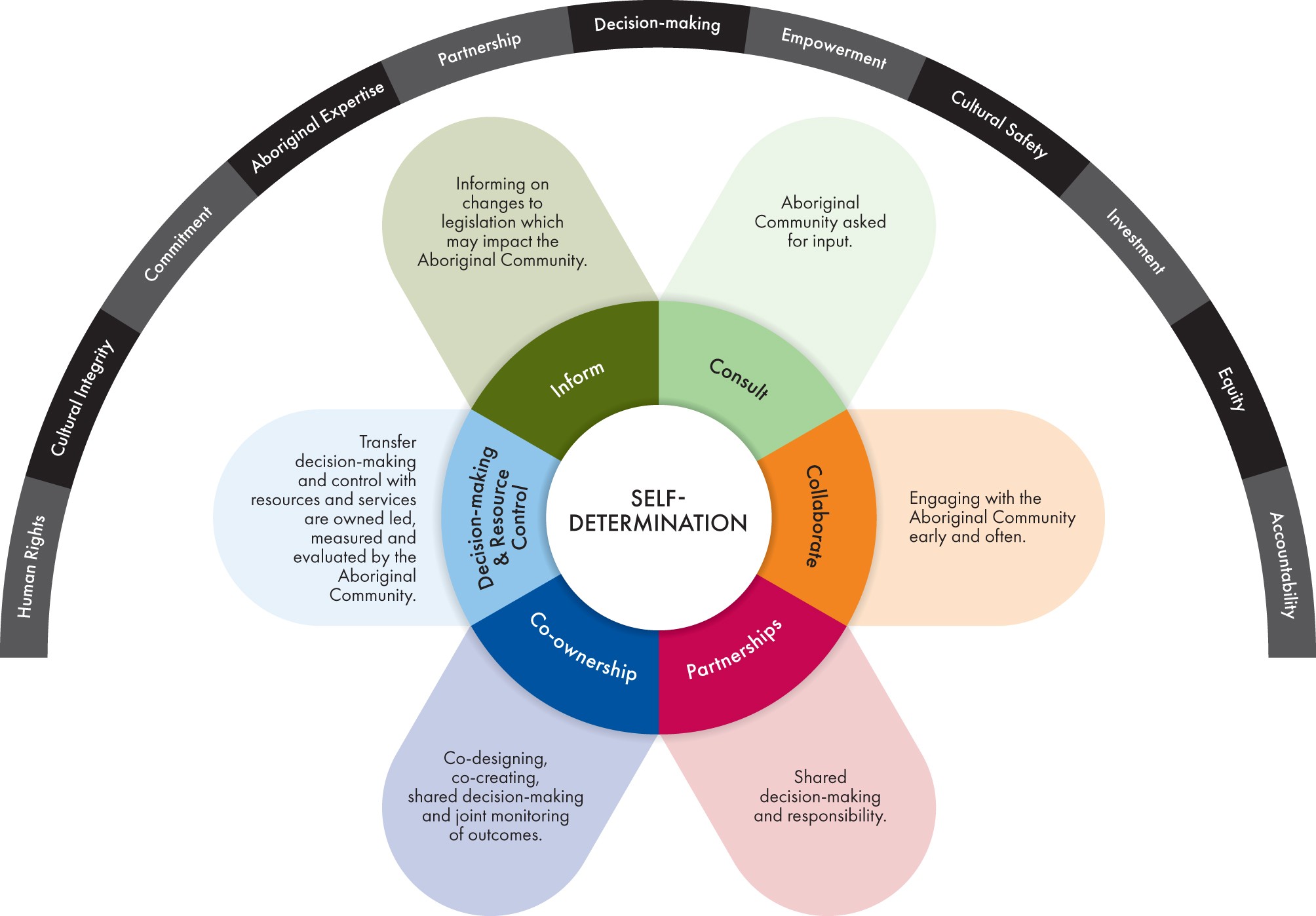
Aboriginal Employee Self-Determination Reform Working Group
The Aboriginal Self-Determination Reform Working Group (SDWG) was comprised of key Aboriginal employees of Victoria Police. They led the work to support self-determination that impacts Aboriginal employees including employment and cultural safety across the organisation.
The SDWG membership consisted of:
- Inspector Stephen Braithwaite, Co-chair, Dunguludja Yapaneyput Aboriginal Employee Network Council (DYAENC)
- Mick Coombes, Executive Treaty Coordinator, Priority and Safer Communities Division (PSCD)
- Aunty Eva-Jo Edwards, Aboriginal Community Liaison Officer (ACLO)
- Selina Grizos, DYAENC
- Sue Hine, Co-chair, DYAENC
- Jacqui Marion, Manager, Aboriginal Community Portfolio, PSCD
- Shane Roberts, DYAENC
- Inspector Christian Wake, DYAENC.
Updated