
- Date:
- 30 Oct 2026
Foreword from the Chief Commissioner of Police
In accordance with the Financial Management Act 1994, I am pleased to present the Victoria Police annual report for the 12 months ending 30 June 2026.
This report is a record of our performance against a range of statutory requirements and the government’s budget performance measures.
We have also included an overview of our most important programs, initiatives and achievements in the past year.
2025-26 in review
Across the state, our police, protective services officers and employees continue to serve with compassion, respect, integrity, professionalism, and courage. They help to keep Victorians safe, and feeling safe, in their homes, on our roads, on public transport and in the places where people live, work, gather and play.
During 2025–26, Victoria Police set a clear direction for the future through our strategy, A Safe Victoria, the Community First operating model and our refreshed organisational values. Together, it describes who we are, what we stand for and how we will deliver policing services for the community.
We completed the first phase of organisational redesign, aligning our structure more closely to our strategy and community needs. This included establishing the Prevention, Community and Partnerships portfolio, reinforcing community-focused policing, prevention, early intervention and sustained collaboration and partnership.
Our priority is straightforward: build trust and confidence, reduce crime and harm, and ensure our people have what they need to serve the community well. These priorities guide the choices we make and the way we respond to the needs of communities across Victoria.
We enhanced visible, intelligence-informed policing through initiatives including Operation Pulse, which increased police and protective services officer presence in major shopping centres, and a more flexible Public Transport Policing Model to better match police presence to risk and demand.
We also continued to respond to complex and serious crime and harm. The newly-established State Command and Coordination Centre has improved how operational information and intelligence is shared, while dedicated operations and taskforces have disrupted organised crime, strengthened our response to serious and violent youth offending, and supported road safety through targeted enforcement.
The safety of police and the community has remained at the centre of everything we do. Following the tragic events at Porepunkah in August 2025, Operation Summit demonstrated the dedication and resilience of our people, and the importance of strong partnerships with agencies and local communities. I again acknowledge all those affected and thank everyone who supported Victoria Police during that difficult time.
During the year, we progressed the Uplift program and other practical reforms to build on our capability, support the frontline and improve the way we work. This included a focus on reducing bureaucracy, improving technology, developing leadership, supporting recruitment and retention, and enhancing coordination across the state.
We have introduced a new code of conduct, reviewed our governance and committee arrangements, and maintained a strong focus on risk, audit and assurance—foundations that are essential to a strong, accountable and trusted police service.
Through recruit training reforms, investment in operational capability, enhanced emergency response support and continued recognition of workplace inclusion, we are building the capability, culture and systems needed to serve the community with confidence.
I thank every Victoria Police employee for their service and commitment, and acknowledge our partners across government, emergency services, community organisations and the Victorian community for their continued support.
As we look ahead, our focus remains clear: delivering our strategy, strengthening trust and confidence, reducing harm and working together for a safer Victoria.
Victoria Police is here for every Victorian.

Mike Bush CNZM
Chief Commissioner
Victoria Police
Publication information
Acknowledgement of Country
Victoria Police respectfully acknowledges the Traditional Owners of country throughout Victoria.
We pay our respects to Elders, past and present, and continue to recognise and embrace the fact that Aboriginal people are connected to the oldest, continuous culture and history.
Published October 2026
Authorised and published by Victoria Police
Victoria Police Centre
311 Spencer Street, Docklands VIC 3008
police.vic.gov.au
All rights reserved. No part of this publication may be reproduced, stored in a retrieval system, or transmitted in any form or by any means without the prior written permission of the State of Victoria (through Victoria Police).
© State of Victoria (Victoria Police) 2026
This publication is copyright. No part may be reproduced by any process except in accordance with the provisions of the Copyright Act 1968.
Victoria Police Annual Report 2025-26: Our organisation
Victoria Police was established in 1853 and provides policing services to the Victorian community 24 hours a day, seven days a week.
We work every day to keep all Victorians safe.
Our vision
Our vision is for a safe Victoria, where everyone is safe and feels safe. We are committed to building trust and confidence, reducing crime and harm and enabling our people to deliver exceptional policing services.
Through intelligence-informed decision-making, a prevention-focused approach and strong partnerships, we work to strengthen community safety and support the Victorian community.
Our role
Our role is to serve the Victorian community and uphold the law to promote a safe, secure and orderly society. We achieve this by:
- preserving the peace
- protecting life and property
- preventing the commission of offences
- detecting and apprehending offenders
- helping those in need of assistance.
Our values
Our values are central to who we are. They define what we stand for, guide how we behave, and underpin every decision and action we take. They reflect our commitment to the Victorian community and to each other, setting the standard for how we honour the responsibilities entrusted to us.
The trust and confidence of the community are fundamental to our ability to serve. Together, our values provide the foundation for earning and maintaining that trust, guiding the behaviours that strengthen our relationships with the community, our partners and each other.
Our values are:
Compassion
We act with compassion through tolerance, understanding and impartiality.
Respect
We treat everyone fairly, with dignity and respect; they are valued and included.
Integrity
We act with integrity and honour, being fair and respectful of both the law and human rights.
Professionalism
We are accountable and professional; committed to maintaining the highest standards of conduct and presentation.
Courage
We act with courage and uphold the values in the face of adversity.
Our services
Victoria Police operates under the Victoria Police Act 2013 and delivers policing services in support of A Safe Victoria, Victoria Police’s strategy, and the Community First operating model.
Our approach is focused on visible policing presence, prevention of crime and harm, and effective responses to emergencies, incidents and community needs.
Services are delivered through a combination of frontline policing, specialist capabilities and partnerships that support safer outcomes for Victorians.
Our current services are grouped across three core areas:
- Presence
- highly-visible policing – more street than station
- intelligence-informed policing
- proactive policing activities aimed at harm reduction
- community engagement with a focus on victims, priority groups and those at risk
- Prevention
- deterrence, early intervention through partnerships and community safety initiatives
- disrupting, preventing and detecting crime
- regulatory services that prevent harm through education, compliance and enforcement activities
- Response
- responding to emergencies, critical incidents and major events
- investigating and prosecuting crime
- victim support and offender management.
These services are delivered through a range of pathways, including in-person policing, digital and phone channels, and on-site services.
This includes police patrols, road policing, community engagement activities, emergency and non-emergency reporting channels, online reporting, police stations, court services, deployment and offender processing centres, and multidisciplinary centres.
Find further information about our services, including regional maps.
Victoria Police regions
Victoria Police serves the Victorian community across four regions. These are:
- North West Metro Region — encompassing inner western and northern areas of Melbourne, across five divisions
- Southern Metro Region — serving Melbourne’s southern and bayside communities, across four divisions
- Eastern Region — a geographically-diverse region, incorporating metropolitan, rural, and alpine areas, across six divisions
- Western Region — the largest geographic area covering 60 per cent of the state, across six divisions.
These regional boundaries correspond with regions used by other Victorian Government departments, enhancing the delivery of government services, particularly in emergency management
Map of Victoria regions


Our operating environment
Victoria Police operates under the Victoria Police Act. Disclosures required under the Act and other legislation, as well as additional reporting requirements, are presented in Chapter 5 – Other disclosures.
Our organisational structure
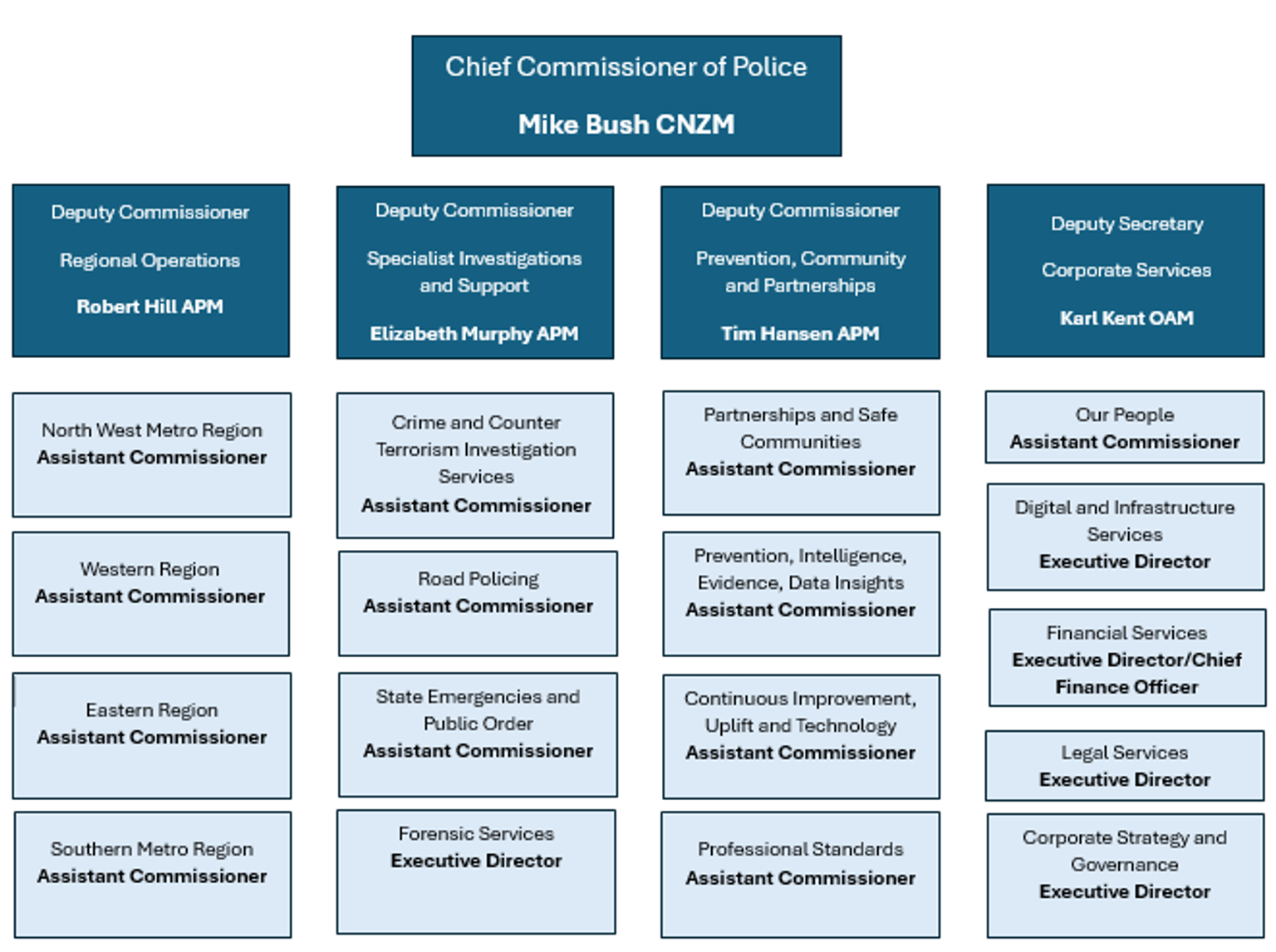
Three Deputy Commissioners and one Deputy Secretaries support the Chief Commissioner of Police.
Organisational chart as at 30 June 2026
Senior leadership group
Executive Leadership Board
The Executive Leadership Board is the primary decision-making body for Victoria Police and comprises the Chief Commissioner of Police, Deputy Commissioners and Deputy Secretary.
The board is responsible for providing leadership, strategic direction and oversight for the organisation, setting culture and modelling Victoria Police values.
As at 30 June 2026, the members of the Executive Leadership Board were:
- Mike Bush CNZM – Chief Commissioner of Police
- Robert Hill APM – Deputy Commissioner, Regional Operations
- Elizabeth Murphy APM – Deputy Commissioner, Specialist Investigations and Support
- Tim Hansen APM – Deputy Commissioner, Prevention, Community and Partnerships
- Karl Kent OAM – Deputy Secretary, Corporate Services.
Oversight and assurance
Audit and Risk Committee
The Audit and Risk Committee is established under the Financial Management Act 1994. Its objective is to provide independent assurance and assistance to the Chief Commissioner of Police in relation to our risk, control and compliance framework, and external accountability responsibilities.
The committee has no executive powers, except those expressly provided by the Standing Directions 2018 of the Minister for Finance, and powers that may be delegated to it from time to time by the Chief Commissioner of Police.
All committee members are external to Victoria Police. The Audit and Risk Committee members as 30 June 2026 were:
- Sandra (Sam) Andersen (Chair) LLB CPA FAICD FFin
- Stephen Fontana APM
- Megan Haas
- Ramaswamy (Narayan) Prasad MBA FCPA GAICD.
Risk management
Under Standing Direction 3.7.1 – Risk Management Framework and Processes, Victoria Police must apply the Victorian Government Risk Management Framework 2025 (VGRMF).
We must consider material risks in decision making and appropriately manage risk while considering our obligations, constraints, and objectives. Effective risk management enhances service delivery and community safety outcomes.
The VGRMF describes the minimum risk management requirement to demonstrate that risks are managed effectively. It adopts the ISO 31000:2018 Risk management — Guidelines, an internationally accepted basis for best practice risk management.
Risk management obligations include the requirement that risk considerations are documented and reflected in the organisation’s overall governance, strategic planning, performance management, financial management, and service delivery processes and outcomes.
The Victoria Police Risk Management Framework aligns with the VGRMF and incorporates the Victoria Police Risk Appetite Statement and risk evaluation matrix.
During 2025–26, we completed our annual review of the Risk Management Framework, Strategic Risk Profile and Risk Appetite settings to ensure they remained current and aligned with the organisation's operating environment and risk management obligations.
The Executive Leadership Board recognises risk management as an integral part of organisational culture, policies, systems and processes required to ensure community safety. The Executive Leadership Board is committed to advancing a positive risk culture to enhance understanding by all employees and contractors.
This will support employees to manage risks in all areas of responsibility through sound risk management practices.
Victoria Police Annual Report 2025-26: Our people
Victoria Police is committed to enabling a workforce where our people are leaders, are safe and supported, are valued and included, are enabled and are high performing.
We foster a safe, respectful and inclusive workplace that supports the health, safety and wellbeing of our people and enables them to deliver policing services to the Victorian community.
Workforce overview
Victoria Police has 20,790 full-time equivalent (FTE) employees, comprising of police officers, protective services officers (PSOs), police custody officers (PCOs) and Victorian Public Service (VPS) employees.
Further details about our workforce numbers can be found in Chapter 5 – Other disclosures.
Full-time equivalent (FTE) summary
| Employees (FTE) | As at 27 June 2026 | As at 28 June 2026 |
|---|---|---|
| Police | 15,442 | 15,909 |
| Police recruits | 246 | 110 |
| PSOs | 1473 | 1462 |
| Reservists | 1 | 2 |
| PCOs | 296 | 321 |
| VPS employees | 3332 | 3528 |
| Total | 20,790 | 21,332 |
Notes:
This table is prepared in accordance with Financial Reporting Direction (FRD) 29 Workforce Data disclosures in the Report of Operations – public service employees requirements and excludes employees who were not on salary at the end of the last pay period of the financial year (which ended 28 June 2025 for 2024–25 and 27 June 2026 for 2025–26).
Due to rounding, the FTE total may not tally as the figures have been rounded to the nearest whole number, in line with FRD 29.
PCOs are VPS employees but are listed separately. This table excludes employees who are employed by statutory- and nationally-funded bodies administered by Victoria Police.
A commitment to equality and inclusivity
Victoria Police is committed to fostering a safe, respectful and inclusive workplace that reflects the diversity of the Victorian community.
During 2025–26, we continued to advance gender equality, diversity and inclusion through the development of new action plans, Aboriginal inclusion initiatives, leadership development programs and targeted workforce programs designed to support cultural safety, workforce participation and employee wellbeing.
Key achievements during the year included completing all actions under the Chief Commissioner’s Statement of Commitment to the Yoorrook Justice Commission, developing the Gender Equality, Diversity and Inclusion Action Plan 2026–2029, investing in employee-led inclusion initiatives, and strengthening leadership capability to support a more inclusive and representative workforce.
This work is guided by the Equal, Safe and Strong: Victoria Police Gender Equality Action Plan 2020–2030 and Victoria Police Workforce Diversity and Inclusion Framework 2023–2030, which provide the foundation for ongoing cultural and workforce reform.
Employment conditions
Legislation, enterprise agreements and Victoria Police policy govern the terms and conditions of employment for our employees. In addition to the Fair Work Act 2009, and Fair Work Regulations 2009, our police officers and PSOs are governed by the Victoria Police Act 2013 and Victoria Police Regulations 2024. Our VPS employees (including PCOs) are governed by the Public Administration Act 2004, public sector industrial relations policies and the Victoria Public Sector Commission’s VPS common policies.
The employment conditions of Victoria Police employees are covered by dedicated enterprise agreements, including the Victoria Police (Police Officers, Protective Services Officers, Police Reservists and Police Recruits) Enterprise Agreement 2025 and the Victorian Public Service Enterprise Agreement 2024.
2025–26 Honour and awards
Victoria Police recognise the exceptional service, professionalism and contribution of employees and members of the community who have made significant contributions to keeping Victoria safe.
In 2025–26, 37 Victoria Police employees received an honour or award, four community members received a commendation, and one business received a business commendation.
A list of recipients who consented to publication of their details can be found in Appendix C.
Occupational health, safety and wellbeing
Victoria Police remain committed to supporting the health, safety and wellbeing of our employees. During 2025–26 we continued to strengthen our approach to preventing and managing both physical and psychosocial harm, recognising the complex and often demanding environments in which our people work.
Our focus during the year included promoting mentally healthy workplaces, strengthening safety leadership and culture, and providing timely access to support for employees.
Victoria Police Annual Report 2025-26: Our performance
Victoria Police’s performance during the 2025–26 financial year is measured against a range of objective indicators.
A summary of our financial performance shows how we achieve our goals with the resources available.
Performance summary
In 2025–26, Victoria Police received a total operating budget of $4.508 billion to deliver policing services to the Victorian community 24 hours a day, seven days a week.
We are accountable to the Victorian Government and the community for how we use these resources and for the outcomes we deliver.
This chapter reports Victoria Police’s performance against the measures and targets set out in the Victorian Government Budget Papers and Department Performance Statement.
Progress against the priorities and actions in the Victoria Police Corporate Plan 2025–2026 is outlined in Chapter 4 – Year in review.
Performance against objective indicators
Victoria Police reports against the objectives and indicators published in the Victorian Government Budget Papers and Department Performance Statement. These indicators measure our performance in delivering policing and community safety services and our contribution to community safety outcomes.
| Objective | ||||
|---|---|---|---|---|
| Ensuring community safety through policing, law enforcement and prevention activities | ||||
| Output | ||||
| Policing and community safety | ||||
| Indicators | ||||
| Community safety during the day and at night | Community safety on public transport | Crime statistics | Number of road fatalities | Number of road injuries |
Source: Department Performance Statement 2025–26
Performance data for the “Community safety during the day and at night” and “Community safety on public transport” indicators is sourced from the annual National Survey of Community Satisfaction with Policing (NSCSP) and published in the Commonwealth Productivity Commission’s Report on Government Services (RoGS) each year.
Due to survey and publication timeframes, the most current NSCSP data available relates to the 2024–25 financial year and is used in this annual report. These results were also reported in the 2026 RoGS.
The 2025–26 NSCSP results will be published in the 2027 RoGS and reported in the Victoria Police Annual Report 2026–27.
Survey respondents are asked to rate how safe they feel across a range of settings, from "very unsafe" to "very safe". The following tables report the proportion of Victorian respondents who indicated they felt "safe" or "very safe".
Future reporting of community perception measures
The contract with the NSCSP service provider concluded on 30 June 2026. The Australia New Zealand Policing Advisory Agency (ANZPAA) is currently exploring alternative arrangements for the future measurement of community perceptions of safety, confidence and satisfaction with policing.
As a result, arrangements for the future measurement and reporting of NSCSP-derived indicators are currently under review.
Performance against output measures for policing and community safety
Victoria Police contributes to community safety through policing, law enforcement, crime prevention, emergency response and support to the justice system.
These activities support the Victorian Government's objective of ensuring community safety through policing, law enforcement and prevention activities.
The following section presents Victoria Police's performance against the output measures and targets published in the Department Performance Statement 2025–26 and demonstrates the outcomes achieved through the delivery of policing and community safety services during the year.
Performance against output measures for policing and crime prevention
| Performance measures | Unit of measure | 2025–26 actual | 2025–26 target | Performance variation (%) | Result |
|---|---|---|---|---|---|
| Quantity | |||||
| Community calls for assistance to which a Victoria Police response is dispatched | Number | 1,107,773 | 1,200.000 | -7.7 | ■ |
| The actual is lower than the target due to growth in community calls for assistance being lower than anticipated when the target was established. | |||||
| Contravention of family violence intervention order offences per 100,000 population | Number | 860.2 | 893 | -3.7 | ◯ |
| Crimes against property – excluding family violence related crime (rate per 100,000 population) | Number | 4807.1 | 4100 | 17.2 | ■ |
| The actual is higher than the target as cost of living pressures, recidivist offending and drug use are considered likely contributors to offending against property. | |||||
| Crimes against property – family violence related (rate per 100,000 population) | Number | 177.9 | 171 | 4.0 | ✔ |
| Crimes against the person – excluding family violence related crime (rate per 100,000 population) | Number | 734.2 | 660 | 11.2 | ■ |
| The actual is higher than the target due to increased offences against the person, including growth in sex offences and assault-related offending. | |||||
| Crimes against the person – family violence related crime (rate per 100,000 population) | Number | 603.7 | 580 | 4.1 | ✔ |
| Number of alcohol screening tests conducted | Number | 3,152,691 | 3,000,000 | 5.1 | ✔ |
| The actual is higher than the target due to increased roadside enforcement activity undertaken as part of Victoria Police’s commitment to deliver the Road Safety Strategy. | |||||
| Number of family violence incidents recorded | Number | 102,836 | 108,081 | -4.9 | ◯ |
| Number of impounded/surrendered vehicles related to high risk driving behaviours or other traffic offences | Number | 7922 | 14,628 | -45.8 | ■ |
| The actual is lower than the target due to resource limitations, the Vehicle Impound Support Unit operated at a reduced capacity. | |||||
| Number of prohibited drug screening tests conducted | Number | 173,967 | 150,000 | 16.0 | ✔ |
| The actual is higher than the target due to the additional 25,000 Transport Accident Commission-funded tests undertaken in the reporting cycle, enabling Victoria Police to undertake more roadside drug screening than originally planned. | |||||
| Number of youth referrals | Number | 3853 | 3260 | 18.2 | ✔ |
| The actual is higher than the target due to the expansion of the Embedded Youth Outreach program (EYOP) to Shepparton and Caroline Springs. Victoria Police has also strengthened its victim-centred response through a mandatory eLearn package and distributed resource material across police stations. | |||||
| Police record checks and police information reports compiled | Number | 959,120 | 975,000 | -1.6 | ◯ |
| Quality | |||||
| Perceptions of safety – walking locally at night | Per cent | 43.1 | 55 | -21.6 | ■ |
| The actual is lower than the target due to a change in the data collection methodology for the National Survey of Community Satisfaction in Policing (NSCSP), constituting a break in the data series. Broader environmental factors may also influence perceptions of safety, including declining social cohesion, increasing social polarisation, cost-of-living pressures and heightened exposure to misinformation and disinformation through digital platforms. | |||||
| Proportion of Family Incident Report affected family members receiving referrals | Per cent | 87.6 | 87 | 0.7 | ✔ |
| Proportion of community satisfied with policing services (general satisfaction) | Per cent | 53 | 80 | -33.8 | ■ |
| The actual is lower than the target due to a change in the data collection methodology for the National Survey of Community Satisfaction in Policing (NSCSP), constituting a break in the data series. Community satisfaction with policing services may also be influenced by broader societal factors, including declining trust in institutions, increasing social polarisation and heightened public scrutiny of government and law enforcement agencies. | |||||
| Proportion of drivers tested by road safety cameras who comply with posted speed limits | Per cent | 99.7 | 99.5 | 0.2 | ✔ |
| Proportion of successful prosecution outcomes | Per cent | 94.3 | 92 | 2.5 | ✔ |
| Proportion of the community who have confidence in police (an integrity indicator) | Per cent | 57.8 | 82 | -29.5 | ■ |
| The actual is lower than the target due to a change in the data collection methodology for the National Survey of Community Satisfaction in Policing (NSCSP), constituting a break in the data series. Broader environmental factors may also influence community confidence in police, including declining trust in public institutions, increasing social polarisation, heightened scrutiny of law enforcement, and the influence of misinformation and disinformation through traditional and digital media. | |||||
| Timeliness | |||||
| Proportion of crimes against the person resolved within 30 days | Per cent | 35.4 | 45 | -21.3 | ■ |
| The actual is lower than the target due to workforce availability challenges impacting investigation capacity and clearance rates. | |||||
| Proportion of property and deception offences resolved within 30 days | Per cent | 19.0 | 25 | -24.0 | ■ |
| The actual is lower than the target due to workforce availability challenges impacting investigation capacity and clearance rates. | |||||
| Cost | |||||
| Total output cost | $ million | 4,854.4 | 4508.3 | 7.5 | ■ |
Source: Victoria Police, the National Survey of Community Satisfaction with Policing and the Crime Statistics Agency
Key:
✔ Performance target achieved or exceeded – performance greater than target, either within 5 per cent or exceeding 5 per cent variance.
◯ Performance target not achieved – performance less than target by less than 5 per cent (or $50 million for cost measures only) variance.
■ Performance target not achieved – performance less than target by more than 5 per cent (or $50 million for cost measures only) variance.
Road safety
Victoria Police's Road Policing Command contributes to the Safe System approach to road safety through highly visible and sustained enforcement activities aimed at reducing road trauma.
Holiday periods continue to present elevated risks on Victorian roads and, throughout 2025–26, Victoria Police conducted eight major, state-wide road policing operations targeting impaired driving, drug driving and other high-risk road user behaviours.
Financial performance
2025–26 | 2024–25 | 2023–24 | 2022–23 | 2021–22 | |
|---|---|---|---|---|---|
| Financial performance | |||||
| Income from government | |||||
| Total Income from Transactions | 4,849,568 | 4,574,811 | 4,317,179 | 4,166,583 | 4,102,352 |
| Total Expenses from Transactions | 4,846,334 | 4,610,341 | 4,350,210 | 4,163,706 | 4,100,602 |
| Net Result from Transactions | 3,234 | (35,530) | (33,031) | 2,877 | 1,750 |
| Net Result | 36,408 | (37,103) | (4,588) | 41,178 | 86,939 |
| Cash Flows | |||||
| Net Cash Flow from Operating Activities | 187,255 | 171,837 | 193,428 | 166,849 | 152,568 |
| Net Cash Flow from Financing Activities | (115,412) | (120,356) | (58,385) | 101,390 | (64,179) |
| Balance Sheet | |||||
| Total Assets | 5,191,742 | 5,000,875 | 4,978,010 | 4,906,632 | 4,804,153 |
| Total Liabilities | 2,949,693 | 2,992,496 | 2,937,322 | 2,889,612 | 2,831,219 |
| Net Worth | 2,242,049 | 2,008,379 | 2,040,687 | 2,017,020 | 1,972,934 |
Overview
The Victorian Government considers the net result from transactions to be the most appropriate measure of financial management directly attributable to government policy.
This measure excludes the effects of revaluations (holding gains or losses) arising from changes in market prices and other changes in the volume of assets shown under ‘other economic flows’ on the comprehensive operating statement, which are outside the control of Victoria Police.
Net result from transactions
Victoria Police recorded a net result from transactions of $3.2 million in 2025–26, an improvement of $38.8 million from the $35.5 million deficit reported in 2024–25. The improvement reflects income growth exceeding expense growth during the year, with total income from transactions increasing to $4.850 billion and total expenses from transactions increasing to $4.846 billion.
Income growth was primarily supported by higher Victorian Government funding. Despite vacancies, employee expenses remained the main driver of cost growth, increasing by 7 per cent, largely due to enterprise agreement outcomes and higher WorkCover costs. This was partly offset by lower depreciation and amortisation expenses and a slight reduction in operating expenditure despite inflationary cost pressures.
Net results
Victoria Police reported an overall net result of $36.4 million in 2025–26. This was primarily attributable to an actuarial gain on long service leave liabilities, compared with an actuarial loss in the prior year. The movement mainly reflected an increase in the discount rate from 4.203 per cent to 4.736 per cent.
Net cash inflows from operating activities Net cash inflows from operating activities were $187.3 million, an increase of $15.4 million from 2024–25. The increase was mainly due to higher receipts from the Victorian Government, partly offset by higher payments to employees and suppliers.
Net cash outflows from financing activities
Net cash outflows from financing activities were $115.4 million, a decrease of $4.9 million from 2024–25. This was primarily due to lower repayments of borrowings and lease liabilities, partly offset by lower capital contributions received during the year.
Total assets
Total assets increased by $190.9 million (4 per cent), from $5.001 billion to $5.192 billion in 2025–26. The increase was primarily driven by the managerial revaluation of owned buildings and leasehold improvements, together with additions arising from capital projects. The revaluation was undertaken after cumulative valuation movements exceeded the 10 per cent threshold indicated by Valuer-General Victoria indices.
Capital investment during the year supported the delivery and upgrade of key police infrastructure, including the completion of Clyde North Police Station and Benalla Police Station and the major refurbishment of Narre Warren Police Station.
Further investment was made in leased accommodation, including new facilities and lease renewals across metropolitan and regional locations.
Total liabilities
Total liabilities decreased by $42.8 million (1 per cent). This reduction was partly offset by higher employee-related provisions, including annual leave and long service leave liabilities.
Net worth
Net worth increased by $233.7 million, or 12 per cent, to $2.242 billion at 30 June 2026. The increase was mainly driven by the revaluation of buildings and leasehold improvements, together with additions from completed capital projects, including the Benalla Police Station and Clyde North Police Station and reaching near practical completion.
Victoria Police Annual Report 2025-26: Year in review
In 2025–26, Victoria Police delivered initiatives and projects to build trust and confidence, reduce crime and harm, and enable our people. These initiatives and projects were part of a long-term strategy which supports our purpose for all Victorians to be safe and feel safe.
A Safe Victoria: Victoria Police strategy
A Safe Victoria sets our long-term direction and reflects our core purpose for all Victorians to be safe and feel safe.
Introduced during 2025–26 alongside the Community First Operating Model and refreshed organisational values, it provides the strategic framework that guides how Victoria Police will deliver services, support its people and work with the community.
The strategy is underpinned by three strategic priorities:
- build trust and confidence
- reduce crime and harm
- enable our people.
Together, these priorities provide a clear and coordinated framework to guide Victoria Police in responding to emerging challenges, reducing harm, strengthening community trust and confidence and delivering policing services to the Victorian community.
The Victoria Police Corporate Plan 2025–26
The Victoria Police Corporate Plan 2025–26 supports the delivery of A Safe Victoria by outlining the priority initiatives to be progressed during the reporting period. It translates our strategic priorities into a coordinated program of work across the organisation.
The corporate plan sets out initiatives aligned to building trust and confidence, reducing crime and harm and enabling our people. These initiatives include major organisational reforms, investments and service improvements delivered across Victoria Police.
Prepared in accordance with the Resource Management Framework, published by the Department of Treasury and Finance, the Corporate Plan forms part of the Victoria Police integrated organisational planning framework.
The plan is refreshed annually to reflect changes in organisational priorities, government objectives and evolving needs of the Victorian community.
Build trust and confidence
Initiatives and projects
Updates as at 30th June 2026.
Key achievements in 2025–26

Enhanced safety at major shopping centres
- 60,000 Public contacts
- 1300+ Arrests
- 12+ Weapons seized
Modernising police training
- New 25-week recruit training program
- Streamlined learning model
- Supporting frontline workforce growth
Reduce crime and harm
Initiatives and projects
Updates as at 30th June 2026.
Key achievements in 2025–26
Key achievements in 2025–26
Enable our people
Initiatives and projects
Updates as at 30th June 2026.
Key achievements in 2025–26
Victoria Police Annual Report 2025-26: Aboriginal-focused initiatives and outcomes
Victoria Police continued to progress its commitments to the Yoorrook Justice Commission during 2025–26, working in partnership with Aboriginal communities to support meaningful change, strengthen accountability and improve outcomes for Aboriginal people. This chapter reports on key Aboriginal-focused initiatives, actions and outcomes delivered during the year.
Victoria Police First Peoples Committee
The Chief Commissioner’s Statement of Commitment set out 79 actions to be delivered across 2023 to 2025, focused on monitoring and accountability, cultural competence and human rights.
The Victoria Police First Peoples Committee provided oversight of implementation and co-chaired by a Senior Aboriginal Community Representative and a Deputy Commissioner.
On 17 December 2025, the Committee concluded its work through the acquittal of the final actions in the Statement of Commitment.
This work was undertaken in partnership with the Victorian Aboriginal community and has established a foundation for Victoria Police to continue working in the spirit of collaboration and self-determination.
Aboriginal Community Liaison Officers
The Aboriginal Community Liaison Officer (ACLO) program was established to address recommendation 231 of the 1991 Royal Commission into Aboriginal Deaths in Custody.
ACLOs are Victorian Public Service employees whose role is to foster trust, understanding and respect between Victoria Police and the Aboriginal community.
They do this by consulting with the community, providing advice to senior police on local Aboriginal issues, and encouraging Aboriginal communities to engage with police to resolve issues.
ACLOs assist with delivering Victoria Police Aboriginal programs including the Aboriginal Youth Cautioning program, Aboriginal Community Justice Panels, Police and Aboriginal Community Protocols Against Family Violence, and Aboriginal Cultural Awareness Training.
As at 30 June 2026, there are 17 ACLO positions across metropolitan and regional Victoria.
Aboriginal Justice Forum
At the Aboriginal Justice Forum (AJF71) in August 2025, the Aboriginal Justice Caucus recommended that Victoria Police conduct a review of the ACLO Program, with an objective of revisiting the role of ACLOs in building relationships between the Aboriginal community and Victoria Police.
The last program evaluation was conducted in 2010 by the Cultural and Indigenous Research Centre Australia.
At the Aboriginal Justice Forum (AJF73) in March 2026, the Chief Commissioner of Police committed to supporting a review that will re-evaluate the program’s objectives and deliverables in line with the capabilities of the reclassified ACLO position.
During 2025–26, planning commenced for consultation with the Victoria Police Aboriginal Portfolio Reference Group and the Aboriginal Justice Caucus to support implementation of the review recommendations.
Senior Aboriginal Programs Coordinator
In 2025, a Senior Aboriginal Programs Coordinator role was established to support the ACLO and Police Aboriginal Liaison Officer (PALO) programs and networks.
ACLO program initiatives included:
- The inaugural (online) ACLO Community of Practice was held in July 2025, with a further community of practice held in October 2025. The next ACLO CoP is scheduled to occur in July 2026.
- The ACLO Induction Package and toolkit, which contains an overview of the role to support the onboarding of new ACLOs, was implemented.
- The ACLO Victorian Aboriginal Justice Agreement Regional Aboriginal Justice Advisory Committee representation document, which provides an overview of the governance structures between the Victorian Aboriginal community and government, was implemented.
- Planning started for the ACLO Forum, titled, Walking Together, Strengthening Partnerships.
Police Aboriginal Liaison Officer
In October 2025, Victoria Police conducted a review of the PALO program with statewide PALOs, ACLOs and Regional Aboriginal Justice Advisory Committees through surveys, face-to-face consultation and online meetings.
The purpose of the review was to evaluate the efficiency and effectiveness of the PALO recruitment process.
The PALO Review Focus Group has been established as part of the PALO review, which comprises representation from PALOs, ACLOs and Regional Aboriginal Justice Advisory Committees.
The focus group was established to support implementation of review recommendations, including consideration of recruitment processes, training and program guidance, including:
- co-designing a PALO expression of interest recruitment process
- reviewing and streamlining the PALO Handbook
- integrating recommendations from the ACLO program review that intersect with the PALO program, where required
- exploring a regional training package for PALOs.
We will consult and engage with the Aboriginal Portfolio Reference Group and the Aboriginal Justice Caucus to seek their advice and guidance on the review recommendations and throughout the implementation process, ensuring that the principles of self-determination, including meaningful community participation, are embedded in decision-making.
PALO program initiatives include:
- hosting the inaugural (online) PALO forum in November 2025
- planning commenced for the PALO Forum, Bridging the Gap: Trust, Safety and Action.
There are currently 237 PALOs across Victoria:
- 72 in the Western Region
- 71 in the Eastern Region
- 24 in the Southern Metro Region
- 70 in the North-West Metro Region.
Aboriginal Youth Cautioning Program
Since 2020, the Aboriginal Youth Cautioning Program (AYCP) has given Aboriginal children aged 12 to 17 years the option to access support from Aboriginal community representatives after receiving a caution from police.
The AYCP is consent-based and aims to reduce offending by addressing factors underlying problem behaviours.
During 2025–26, AYCP operated across all police service areas, although levels of implementation and program activity varied across locations.
Through ongoing consultation with Regional Aboriginal Justice Advisory Committees and the Aboriginal Justice Caucus, AYCP provides an enhanced referral pathway that connects Aboriginal young people with culturally relevant support following contact with police.
Police and Aboriginal Community Protocols Against Family Violence
One of our key strategies to address family violence in Aboriginal communities is the Police and Aboriginal Community Protocols Against Family Violence.
The protocols are an agreement between local Aboriginal communities and Victoria Police that document the local police response to family violence where a person identifies as Aboriginal.
The protocols are now established state-wide across 17 localised partnerships between Aboriginal communities, Dhelk Dja representatives and Victoria Police.
These protocols provide an ongoing mechanism for the delivery of localised Aboriginal-led initiatives and actions in accordance with the second Dhelk Dja Action Plan and Action 54 of the Statement of Commitment.
During 2025–26, Victoria Police undertook a review of the Police and Aboriginal Community Protocols Against Family Violence and engaged with the Dhelk Dja Koori Caucus regarding opportunities to strengthen and further develop the program.
Aboriginal Cultural Awareness Training
highlights the importance of working in partnership with Aboriginal communities using self-determination principles to develop culturally competent policing responses.
ACAT aims to improve Victoria Police employees’ awareness and understanding of Aboriginal Victorian peoples, culture, history and contemporary issues, and how these continue to impact the circumstances of Aboriginal people today.
The training encourages employees to reflect on and challenge existing beliefs, biases and assumptions about Aboriginal Victorians. ACAT was endorsed by the ACAT was endorsed by the Aboriginal Justice Caucus in May 2022 and is mandatory for police officers, PSOs and PCOs. Since then, Victoria Police has extended this program to include VPS employees.
In early 2025, prior to commencing development of a refreshed ACAT package, Victoria Police engaged Aboriginal Cultural Consultants to undertake a review of the current training and develop an updated version of ACAT.
ACAT Refresher Training
In June 2025, Victoria Police established an ACAT Refresher Steering Committee to support the development of content through Aboriginal cultural expertise in accordance with the principles of self-determination.
Membership on the ACAT Refresher Steering Committee consisted of two Aboriginal Justice Caucus members.
In August 2025, the ACAT Refresher Steering Committee endorsed the refreshed package to be delivered exclusively as an online e-Learn module for all Victoria Police employees.
Following endorsement, implementation of the mandatory training online module for all Victoria Police employees was approved to commence from 1 July 2026.
Chief Commissioner’s Human Rights Strategic Advisory Committee
The Chief Commissioner’s Human Rights Strategic Advisory Committee (HRSAC) demonstrates Victoria Police’s commitment to delivering policing services that are consistent with contemporary human rights standards and community expectations.
For more than a decade, the Committee has brought together leading human rights institutions, advocacy organisations and community representatives to provide independent strategic advice and oversight on policing policy, practice and service delivery.
In doing so, it supports accountability, transparency and public confidence in Victoria Police.
The Human Rights Strategic Advisory Committee comprises Executive and Commissioner-level representatives from Victoria’s leading human rights institutions, advocacy organisations and peak bodies.
The Committee provides a forum for diverse perspectives and expertise to inform discussion on the human rights impacts of policing, emerging issues and opportunities for continuous improvement.
A significant milestone in 2026 was the introduction of the first co-chair model since the Committee's establishment in 2014.
The Commissioner of the Victorian Equal Opportunity and Human Rights Commission, Victoria’s principal human rights and equal opportunity body, was appointed co-chair.
This new model reflects a shared commitment to meaningful collaboration between Victoria Police and the community it serves.
Victoria Police Human Rights Framework
A key area of focus for the Human Rights Strategic Advisory Committee during 2025–26 was the development of the Victoria Police Human Rights Framework.
The framework sets the direction for ensuring that human rights underpin the organisation’s commitment to A Safe Victoria and demonstrates how the organisation adheres to the Charter of Human Rights and Responsibilities Act 2006 in its service delivery.
Complaints handling
Aboriginal Complaints Support Officer
To strengthen the approach to the management of Aboriginal-identified complaints in 2024–25, the ACSO position was created in Victoria Police’s Professional Standards Command and a PALO network was introduced into the complaints process.
These initiatives were aimed at providing timely and culturally appropriate complaint-handling experience.
The creation of the ACSO position was in response to Action 34 of the Chief Commissioner’s Statement of Commitment to the Yoorrook Justice Commission.
The ACSO is a designated Victorian Public Service role which was only open to Aboriginal and/or Torres Strait Islander people to apply.
As part of the role, the ACSO engages with community elders, Regional Aboriginal Justice Advisory Committees and Local Aboriginal Justice Advisory Committees on local concerns relating to police.
The ACSO also assists services such as Victorian Aboriginal Health Service, the Victorian Aboriginal Legal Service and Corrections Victoria, to better understand the police complaint and discipline system.
Importantly, the ACSO serves as a point of contact for Aboriginal complainants, keeping them updated on key stages of a complaint investigation, providing culturally safe referrals and generally improving the quality of service provided by the organisation to the Aboriginal community.
Complaints data
This section reports complaints data as an outcome of Recommendation 7 of the 2016 audit of Victoria Police complaints handling processes by the IBAC, and Action 15 of the Chief Commissioner’s Statement of Commitment.
A complaint may consist of one or more allegations against one or more employees.
Under the Yoorrook Justice Commission’s findings and the Statement of Commitment, all complaints involving Aboriginal or Torres Strait Islander persons must be recorded on the Victoria Police Register of Complaints Serious Incidents and Discipline, regardless of outcome.
Complaints that can be resolved in the first instance by the Police Conduct Unit in Professional Standards Command and assessed as requiring no formal investigation are now recorded as incidents.
This additional recording process ensures improved governance, engagement and recording of complaints by Aboriginal complainants.
A complaint can be submitted directly by an Aboriginal person or on their behalf by another party.
For reporting purposes, the complainant identity is triaged and forwarded to the ACSO during the assessment period for early engagement.
Complaint classifications
| Classification | Definition | Complaint identity | 2025–26 | 2024–25 | 2023–24 |
|---|---|---|---|---|---|
| Management Intervention Model and Local Management Resolution | Allegations of minor nature regarding service delivery, performance management or professional conduct. | Aboriginal | 1 | 7 | 1 |
| Non-Aboriginal | 238 | 298 | 238 | ||
| Total | 239 | 305 | 239 | ||
| Misconduct– minor/serious/corruption | Misconduct under section 166, of the Victoria Police Act 2013 and section 4 of the Public Administration Act 2004. | Aboriginal | 10 | 9 | 10 |
| Non-Aboriginal | 557 | 809 | 557 | ||
| Total | 567 | 818 | 567 | ||
| Complaints registered as incidents and resolved immediately | Resolved in the first instance by the Police Conduct Unit, Professional Standards Command and no further formal investigation required. | Aboriginal | 83 | 49 | 3 |
| Non-Aboriginal | 544 | 635 | 330 | ||
| Total | 627 | 684 | 333 | ||
| Total | Aboriginal | 94 | 65 | 8 | |
| Non-Aboriginal | 1339 | 1742 | 1597 | ||
| Total | 1433 | 1807 | 1605 | ||
Notes:
Incidents are complaint reports received by the Police Conduct Unit that are assessed to be minor and can be resolved immediately. These are recorded as an incident only.
Percentages have been rounded to simplify the data shown.
Complaint allegations by category and determination per financial year finalised
Complaint allegations made by Aboriginal people
| 2025-26 | 2024-25 | 2023-24 | |||||
|---|---|---|---|---|---|---|---|
| Category | Determination | Count | % | Count | % | Count | % |
| Case to answer | Established | 18 | 19.1 | 19 | 28.8 | 3 | 9.4 |
| Lesser deficiency found | 0 | 0 | 0 | 0 | 0 | 0 | |
| Sub total | 18 | 19.1 | 19 | 28.8 | 3 | 9.4 | |
| No case to answer | False report | 0 | 0 | 0 | 0 | 0 | 0 |
| For intelligence purposes only | 0 | 0 | 0 | 0 | 0 | 0 | |
| Member exonerated | 8 | 8.5 | 15 | 22.7 | 17 | 53.1 | |
| No complaint | 0 | 0 | 0 | 0 | 0 | 0 | |
| Not established | 53 | 56.4 | 30 | 45.5 | 4 | 12.5 | |
| Unable to determine | 14 | 14.9 | 2 | 3.0 | 6 | 18.8 | |
| Unfounded | 0 | 0 | 0 | 0 | 0 | 0 | |
| Withdrawn | 0 | 0 | 0 | 0 | 0 | 0 | |
| Sub total | 75 | 79.8 | 47 | 71.2 | 27 | 84.4 | |
| Other | Conciliated | 0 | 0 | 0 | 0 | 0 | 0 |
| Not finalised | 0 | 0 | 0 | 0 | 0 | 0 | |
| Not proceeded with | 0 | 0 | 0 | 0 | 0 | 0 | |
| Sub total | 0 | 0 | 0 | 0 | 0 | 0 | |
| Other (local management actions) | Not resolved | 0 | 0 | 0 | 0 | 0 | 0 |
| Resolved | 0 | 0 | 0 | 0 | 0 | 0 | |
| Sub total | 0 | 0 | 0 | 0 | 0 | 0 | |
| Other (oversight matters) | No complaint (oversight) | 0 | 0 | 0 | 0 | 2 | 6.3 |
| Oversight completed | 1 | 1.1 | 0 | 0 | 0 | 0 | |
| Sub total | 1 | 1.1 | 0 | 0 | 2 | 6.3 | |
| Total | 94 | 100 | 66 | 100 | 32 | 100 | |
Complaint allegations made by non-Aboriginal people
| 2025-26 | 2024-25 | 2023-24 | |||||
|---|---|---|---|---|---|---|---|
| Category | Determination | Count | % | Count | % | Count | % |
| Case to answer | Established | 1026 | 42.8 | 1117 | 39.3 | 1302 | 28.4 |
| Lesser deficiency found | 0 | 0 | 0 | 0 | 2 | 0.04 | |
| Sub total | 1026 | 42.8 | 1117 | 39.3 | 1304 | 28.5 | |
| No case to answer | False report | 0 | 0 | 0 | 0 | 0 | 0 |
| For intelligence purposes only | 1 | 0.04 | 7 | 0.3 | 1 | 0.02 | |
| Member exonerated | 377 | 15.7 | 505 | 17.8 | 1155 | 25.2 | |
| No complaint | 6 | 0.3 | 22 | 0.8 | 41 | 0.9 | |
| Not established | 582 | 24.3 | 775 | 27.2 | 1306 | 28.5 | |
| Unable to determine | 187 | 7.8 | 186 | 6.5 | 370 | 8.1 | |
| Unfounded | 0 | 0 | 0 | 0 | 8 | 0.2 | |
| Withdrawn | 0 | 0 | 6 | 0.2 | 3 | 0.1 | |
| Sub total | 1153 | 48.1 | 1501 | 52.8 | 2884 | 63.0 | |
| Other | Conciliated | 0 | 0 | 0 | 0 | 0 | 0 |
| Not finalised | 0 | 0 | 0 | 0 | 5 | 0.1 | |
| Not proceeded with | 3 | 0.1 | 1 | 0.04 | 15 | 0.3 | |
| Sub total | 3 | 0.1 | 1 | 0.04 | 20 | 0.4 | |
| Other (local management actions) | Not resolved | 0 | 0 | 0 | 0 | 0 | 0 |
| Resolved | 0 | 0 | 0 | 0 | 2 | 0.04 | |
| Sub total | 0 | 0 | 0 | 0 | 2 | 0.04 | |
| Other (oversight matters) | No complaint (oversight) | 16 | 0.7 | 0 | 0 | 0 | 0 |
| Oversight completed | 197 | 8.2 | 226 | 7.9 | 367 | 8.0 | |
| Sub total | 213 | 8.9 | 226 | 7.9 | 367 | 8.0 | |
| Total | 2395 | 100 | 2845 | 100 | 4577 | 100 | |
Total complaint allegations (aggregated)
| 2025-26 | 2024-25 | 2023-24 | |||||
|---|---|---|---|---|---|---|---|
| Category | Determination | Count | % | Count | % | Count | % |
| Case to answer | Established | 1044 | 41.9 | 1136 | 39.0 | 1305 | 28.3 |
| Lesser deficiency found | 0 | 0 | 0 | 0 | 2 | 0.04 | |
| Sub total | 1044 | 41.9 | 1136 | 39.0 | 1307 | 28.4 | |
| No case to answer | False report | 0 | 0 | 0 | 0 | 0 | 0 |
| For intelligence purposes only | 1 | 0.04 | 7 | 0.2 | 1 | 0.02 | |
| Member exonerated | 385 | 15.5 | 520 | 17.9 | 1172 | 25.4 | |
| No complaint | 6 | 0.2 | 22 | 0.8 | 41 | 0.9 | |
| Not established | 635 | 25.5 | 805 | 27.7 | 1310 | 28.4 | |
| Unable to determine | 201 | 8.1 | 188 | 6.5 | 376 | 8.2 | |
| Unfounded | 0 | 0 | 0 | 0 | 8 | 0.2 | |
| Withdrawn | 0 | 0 | 6 | 0.2 | 3 | 0.1 | |
| Sub total | 1228 | 49.3 | 1548 | 53.2 | 2911 | 63.2 | |
| Other | Conciliated | 0 | 0 | 0 | 0 | 0 | 0 |
| Not finalised | 0 | 0 | 0 | 0 | 5 | 0.1 | |
| Not proceeded with | 3 | 0.1 | 1 | 0.03 | 15 | 0.3 | |
| Sub total | 3 | 0.1 | 1 | 0.03 | 20 | 0.4 | |
| Other (local management actions) | Not resolved | 0 | 0 | 0 | 0 | 2 | 0.04 |
| Resolved | 0 | 0 | 0 | 0 | 0 | 0 | |
| Sub total | 0 | 0 | 0 | 0 | 2 | 0.04 | |
| Other (oversight matters) | No complaint (oversight) | 16 | 0.6 | 0 | 0 | 0 | 0 |
| Oversight completed | 198 | 8.0 | 226 | 7.8 | 369 | 8.0 | |
| Sub total | 214 | 9.0 | 226 | 7.8 | 369 | 8.0 | |
| Grand total | 2489 | 100 | 2911 | 100 | 4609 | 100 | |
Notes:
Totals may not add up due to rounding.
A complaint may consist of one or more allegations against one or more employees. The figures in this table reflect the determination for each allegation not the outcome of a single complaint.
Figures in the table represent all allegations determined (finalised) by financial year and may include complaints lodged in previous financial years.
Data provided for earlier financial years may vary from that previously published due to quality control processes that include capturing historical information.
Percentages have been rounded to simplify the data shown.
Local management actions were removed as a category in 2024 as part of Professional Standards Discipline Transformation Project. Category has remained in this report due to 23–24 financial year data being present.
Recommended actions for complaint allegations for each financial year finalised
Complaint allegations made by Aboriginal people
| Recommendations | 2025-26 | 2024-25 | 2023-24 | |||
|---|---|---|---|---|---|---|
| Count | % | Count | % | Count | % | |
| Admonishment | 2 | 2.1 | 0 | 0 | 0 | 0 |
| Criminal charges | 0 | 0 | 0 | 0 | 0 | 0 |
| Discipline charges | 0 | 0 | 0 | 0 | 0 | 0 |
| Management actions | 13 | 13.8 | 17 | 25.8 | 3 | 9.4 |
| No data recorded | 0 | 0 | 0 | 0 | 0 | 0 |
| No action | 76 | 80.9 | 49 | 74.2 | 29 | 90.6 |
| Resigned/retired | 3 | 3.2 | 0 | 0 | 0 | 0 |
| Terminated | 0 | 0 | 0 | 0 | 0 | 0 |
| Total | 94 | 100 | 66 | 100 | 32 | 100 |
Complaint allegations made by non-Aboriginal people
| Recommendations | 2025-26 | 2024-25 | 2023-24 | |||
|---|---|---|---|---|---|---|
| Count | % | Count | % | Count | % | |
| Admonishment | 245 | 10.2 | 230 | 8.1 | 266 | 5.8 |
| Criminal charges | 32 | 1.3 | 26 | 0.9 | 53 | 1.2 |
| Discipline charges | 71 | 3.0 | 45 | 1.6 | 56 | 1.2 |
| Management actions | 617 | 25.8 | 690 | 24.3 | 855 | 18.7 |
| No data recorded | 9 | 0.4 | 2 | 0.07 | 5 | 0.1 |
| No action | 1317 | 55.0 | 1734 | 61.0 | 3197 | 69.9 |
| Resigned/retired | 97 | 4.1 | 111 | 3.9 | 135 | 3.0 |
| Terminated | 7 | 0.3 | 7 | 0.3 | 10 | 0.2 |
| Total | 2395 | 100 | 2845 | 100 | 4577 | 100 |
Total complaint allegations (aggregated)
| Recommendations | 2025-26 | 2024-25 | 2023-24 | |||
|---|---|---|---|---|---|---|
| Count | % | Count | % | Count | % | |
| Admonishment | 247 | 9.9 | 230 | 7.9 | 266 | 5.8 |
| Criminal charges | 32 | 1.3 | 26 | 0.9 | 53 | 1.2 |
| Discipline charges | 71 | 2.9 | 45 | 1.6 | 56 | 1.2 |
| Management actions | 630 | 25.3 | 707 | 24.3 | 858 | 18.6 |
| No data recorded | 9 | 0.4 | 2 | 0.07 | 5 | 0.1 |
| No action | 1393 | 56.0 | 1783 | 61.3 | 3226 | 70.0 |
| Resigned/retired | 100 | 4.0 | 111 | 3.8 | 135 | 2.9 |
| Terminated | 7 | 0.3 | 7 | 0.3 | 10 | 0.2 |
| Total | 2489 | 100 | 2911 | 100 | 4609 | 100 |
Notes:
Totals may not add up due to rounding
Figures in tables represent outcome actions made against allegations determined (finalised) by financial year and may include outcome actions for complaints lodged in previous financial years.
Data provided for earlier financial years may vary from that previously published due to quality control processes that may capture historical information.
Percentages have been rounded to simplify the data shown.
Cautions
Recommendation 28 of the Yoorrook for Justice report provides that access to pre-charge cautions in the adult criminal legal system in the appropriate cases should be increased by all necessary legislation and administrative means.
This section details the reporting of cautions issued by police in accordance with Victoria Police’s commitment to progress implementation of recommendation 28(c) of the Yoorrook for Justice report.
Cautions issued by Victoria Police
| Indigenous status (a) | 2025–26 | 2024–25 | 2023–24 | 2022–23 | 2021–22 | Change from 2024–25 (%) | Change over 5 years (%) |
|---|---|---|---|---|---|---|---|
| Aboriginal | 1661 | 1933 | 1903 | 1519 | 862 | -14.1 | 92.7 |
| Non-Aboriginal | 12,506 | 13,473 | 12,902 | 11,980 | 9221 | -7.2 | 35.6 |
| Unknown | 579 | 502 | 472 | 422 | 368 | 15.3 | 57.3 |
Source: Crime Statistics Agency – September 2026 release.
Notes: Caution data includes both cautions and warnings.
(a) Indigenous status is derived using the status that Victoria Police has most frequently recorded for the individual and may not represent the status recorded at the time of the incident.